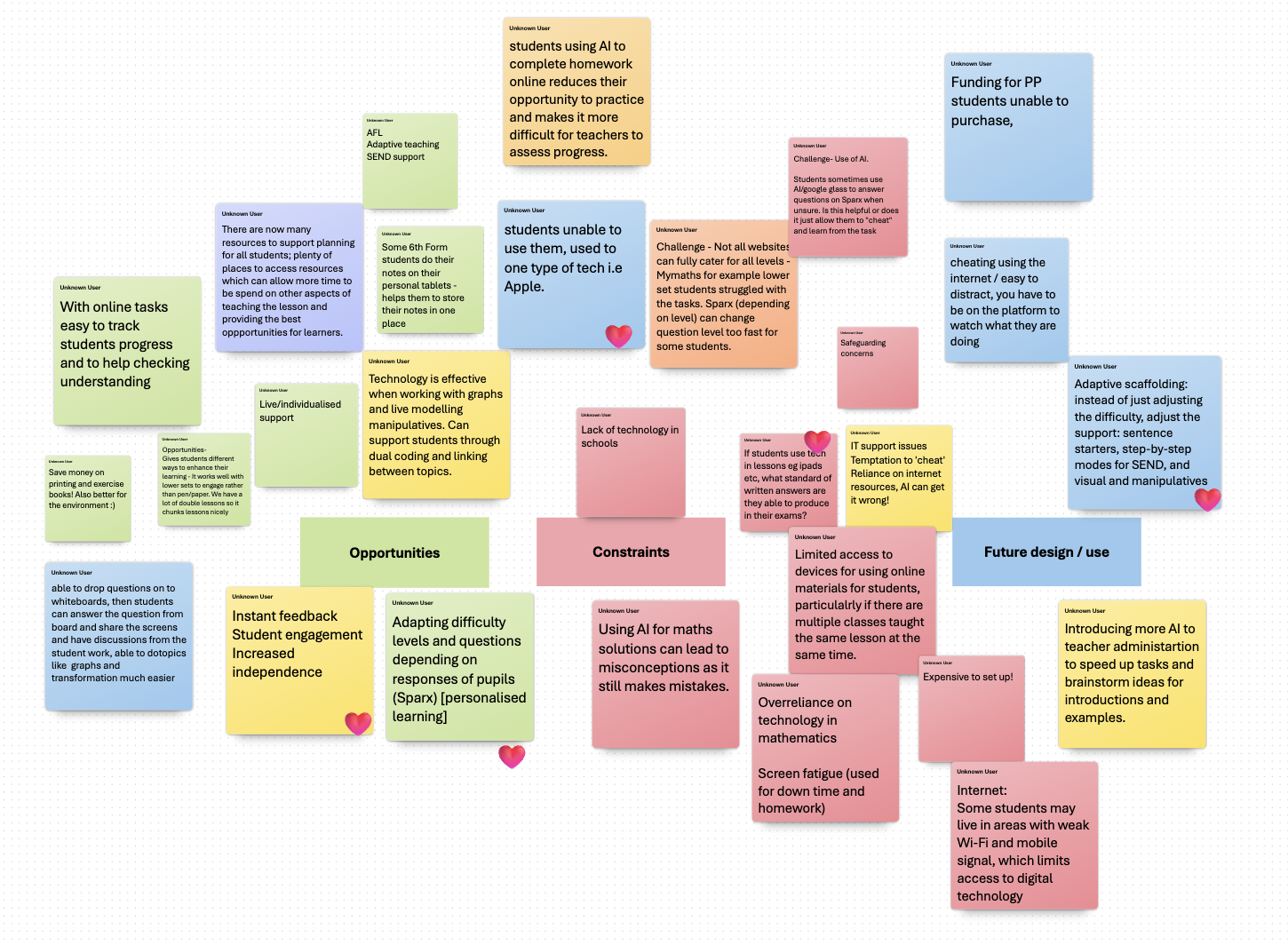
After a fascinating series of workshops in Bristol, Manchester and Edinburgh, as well as engagements with teachers across Wales, our final participatory workshop brought together teachers of English and Maths to discuss some of the more subject-specific considerations of technology use in schools. Participants reflected on the opportunities and challenges presented by technologies within their own everyday teaching practices, using online discussion boards (right).
Maths
For Mathematics teachers, the most important opportunities for technology related to instant feedback, increased practice opportunities, and the ability to track student progress. Teachers reported the way that digital platforms supported them in identifying students’ misconceptions more quickly and targeting support more efficiently. Visual tools, including interactive whiteboards and screen-sharing, could enhance learning in topics such as graphs and transformations, where visual representation is often central to developing student understanding.
However, participants were notably cautious about how far these systems genuinely “personalise” learning. Several teachers questioned whether algorithmic adjustments to difficulty levels constitute meaningful personalisation, or whether they instead produce a narrow form of task differentiation based primarily on correctness rather than process or deep understanding. In some cases, adaptive systems were seen to move students on too quickly, or to reduce complex learning processes into linear progressions that may not reflect how mathematical understanding develops. While dashboards and progress tracking offer a sense of precision and help with diagnostic work, teachers noted that they do not always capture the reasoning behind errors or the conceptual misunderstandings that require teacher interpretation and intervention.
English
For the group of English teachers, technology provided opportunities for more interactive approaches to feedback and modelling. Participants working in well-resourced schools described uusing iPads connected to classroom smartboards to “live mark” student work in front of the class. Compared with traditional visualisers, these methods were considered more flexible and easier to share digitally afterwards through Teams or other online platforms. Participants also noted the value of wider reading platforms to supporting independent scholarship, and there was discussion of the valuable use of different translation tools to support EAL students.
Participants also discussed the opportunities and challenges related to screen-based reading. Accessibility features of devices, such as text enlargement, audio functions, and other multimodal forms of engagement, were viewed as particularly beneficial for SEND students. However, the group questioned whether digital texts may disadvantage some students’ comprehension and concentration compared with physical books.
English teachers also raised concerns about a fragmented digital ecosystem. Teachers described a host of intervention and revision tools provided differentiated support outside the classroom, but noted that students most encounter multiple disconnected platforms, each requiring different forms of navigation and self-regulation. Teachers noted that this can advantage students with stronger organisational skills and home support, while others struggle to make effective use of the available resources.
English teachers additionally reflected on the tension between schools’ increasing reliance on digital platforms and wider societal concerns around screen use and mobile phones. In schools where phones are prohibited, some teachers felt there was a contradiction between discouraging device use socially while simultaneously encouraging digital engagement educationally. Others questioned whether schools risk appearing inconsistent in their messaging about technology.
Common themes
Across both English and Maths, one of the most persistent constraints remained the uneven digital infrastructure and home access. Within the discussion groups, teachers described stark differences in access to reliable hardware, software, and technology beyond schools. The significant gap between the availability of online platforms and the conditions required for students to use them effectively outside the classroom. In school, constraints such as insufficient devices, funding pressures, software payment structures and update requirements, as well as competing demands for technology across classes and year groups, further restrict possibly opportunities. The teachers at the workshop reinforced our finding across the project that infrastructure remains a central equity concern, shaping not only whether EdTech can be used, but whether and how it is experienced in meaningful and sustained ways.
Training and professional development also emerged as concerns. Participants noted that there is often little dedicated time for learning how to use new platforms effectively, leaving teachers to experiment independently. This reflected a broader sense that technological change in schools can outpace the support structures needed to implement it meaningfully.
The use of Generative AI emerged as a major concern across both subjects. Mathematics teachers questioned whether students using AI-generated solutions were genuinely developing problem-solving skills, while English teachers expressed concern that students may increasingly rely on AI-generated responses for coursework preparation, revision, or GCSE speaking and listening assessments. Some questioned whether students were still producing genuinely independent ideas, particularly among high-attaining pupils using GenAI extensively for revision support.
Importantly, participants noted that access to Generative AI, as well as the ability to use them effectively, is itself unevenly distributed. This raises important equity questions about whose learning is being enhanced, whose independent thinking may be undermined, and how schools can support students to engage critically in the future.